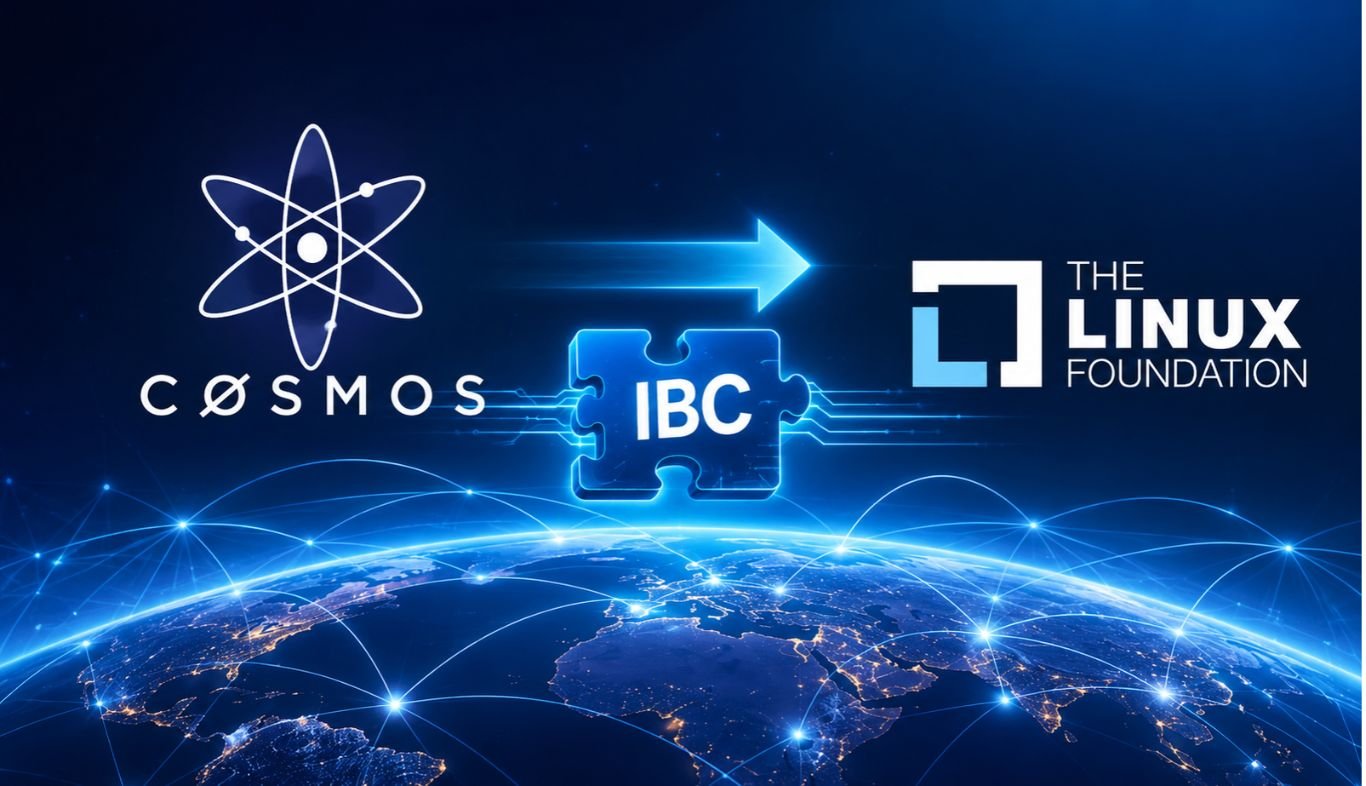
Cosmos IBC Protocol Moves to Linux Foundation: What It Means
Blockchain technology is moving beyond individual networks. The Cosmos IBC Protocol (Inter-Blockchain Communication Protocol) is helping address this shift by enabling independent blockchain networks to communicate and exchange information securely. From decentralized finance (DeFi) and tokenized assets to cross-border payments and enterprise applications, businesses increasingly need different blockchain networks to work together. However, connecting independent networks securely remains one of the industry’s biggest technical challenges.
A significant development in this area came on November 9, 2026, when Cosmos and the Interchain Foundation announced that they are contributing the Inter-Blockchain Communication (IBC) Protocol to the Linux Foundation’s LF Decentralized Trust initiative. The move brings one of the blockchain industry’s established interoperability protocols under a neutral, open-source governance framework.
IBC has been in production since 2021 and, according to Cosmos, has been used across more than 200 networks and processed over $50 billion in transaction volume. Its contribution to LF Decentralized Trust could open the door to broader participation from blockchain developers, technology companies, financial institutions, and infrastructure providers.
But what exactly is changing, and how could this decision influence the future of blockchain interoperability? Let’s examine the announcement and its potential implications.
What Is Cosmos IBC Protocol?
The Inter-Blockchain Communication Protocol, commonly known as IBC, is an open-source interoperability protocol that enables independent blockchain networks and digital ledgers to exchange data and digital assets.
Traditionally, blockchain networks have operated as separate environments. Each network may have its own consensus mechanism, architecture, applications, and token standards. Moving assets or information between these networks can require specialized bridges or other interoperability solutions.
IBC addresses this challenge through a standardized communication framework. It enables compatible networks to establish connections and exchange information using cryptographic verification and protocol-defined processes.
Unlike approaches that depend entirely on a centralized intermediary, IBC allows connected networks to verify messages and proofs through their own infrastructure and verification mechanisms. This helps networks communicate while maintaining their independent governance and technical architecture.
Originally developed for the Cosmos ecosystem, IBC has expanded to support additional environments, including Ethereum, Solana, and Hyperledger Besu.
Its development reflects a broader industry requirement: blockchain networks need ways to communicate without necessarily adopting the same infrastructure or surrendering control to a single platform.
Why Is Cosmos Contributing IBC to the Linux Foundation?
Cosmos says the decision is intended to support IBC’s development as a widely adopted, open interoperability standard.
As blockchain adoption expands into banking, financial services, payments, and tokenization, interoperability is becoming increasingly important. Financial institutions and enterprises may use different digital ledger technologies, making secure communication between these systems essential.
However, a protocol intended for broad industry adoption needs more than technical capabilities. It also benefits from transparent governance, wider participation, and an environment where organizations outside its original ecosystem can contribute to its development.
This is where the Linux Foundation’s LF Decentralized Trust initiative becomes important.
LF Decentralized Trust provides a collaborative environment for developing open-source technologies related to decentralized systems and digital ledgers. Its ecosystem includes projects and organizations working on enterprise blockchain infrastructure and decentralized technologies.
By contributing IBC to this initiative, Cosmos aims to make the protocol more accessible to developers, businesses, and institutions that want to adopt or contribute to an interoperability standard without depending on the governance of a single blockchain ecosystem.
The move could also help IBC reach organizations that are already involved in enterprise blockchain development but may not have previously participated in the Cosmos ecosystem.
What Will Change After IBC Joins LF Decentralized Trust?
The contribution introduces changes to IBC’s governance and project stewardship. However, it does not mean that the protocol is being replaced, discontinued, or converted into a proprietary technology.
Several aspects of the transition are particularly important.
1. Neutral Governance and Broader Industry Participation
One of the most significant changes is the introduction of a neutral governance framework under LF Decentralized Trust.
Under the new arrangement, IBC’s protocol governance will operate through a public project charter and contribution guidelines.
This creates a more formal environment for organizations and independent developers to participate in technical discussions, contribute code, and help shape the protocol’s future.
Neutral governance can be valuable for financial institutions and technology companies that need shared infrastructure but do not want its development to depend exclusively on the priorities of one blockchain ecosystem.
It may also encourage organizations with different technical backgrounds to participate in improving the protocol.
2. IBC Will Remain Open Source
Cosmos has confirmed that IBC’s code will remain free and open source.
Developers and organizations can continue accessing the code, using it in their projects, and contributing improvements through established development processes.
The transition is therefore not a move from open-source technology to a proprietary product. Instead, it changes the framework responsible for the protocol’s governance and long-term stewardship.
This distinction is important for existing users and businesses that have already integrated IBC into their infrastructure.
3. Cosmos Labs Will Continue Supporting IBC Development
The contribution does not mean Cosmos is stepping away from IBC.
Cosmos Labs will remain involved as a maintainer and contributor, supporting the protocol’s technical development and maintenance.
Datachain and OpenZeppelin are also joining the maintainer group. Their involvement is expected to bring additional technical expertise and perspectives to the protocol’s development.
This broader maintainer structure demonstrates that the transition is intended to expand collaboration rather than remove the teams that helped build IBC.
4. The Linux Foundation Will Hold the IBC Trademark
Another important part of the transition concerns the IBC trademark.
LF Decentralized Trust will hold the IBC trademark under its trademark policy, alongside its responsibility for the protocol’s governance framework.
This provides an additional layer of neutral project stewardship.
For organizations considering long-term adoption, transparent governance and clear trademark management can help establish confidence in the continuity and independence of shared infrastructure.
How Could This Strengthen Blockchain Interoperability?
The broader significance of the announcement lies in the possibility of making blockchain interoperability a shared industry priority.
Today, developers and businesses operate across a growing range of public blockchains, private ledgers, enterprise networks, and tokenization platforms. These systems may have different technical requirements, consensus mechanisms, and governance structures.
A common interoperability standard could help reduce fragmentation and make it easier for these environments to communicate.
Here are some areas where wider IBC adoption could make a difference.
Cross-Chain Asset Transfers
IBC can support the movement of digital assets between connected networks.
This capability is relevant to DeFi applications, decentralized exchanges, tokenized assets, and blockchain-based financial products. More standardized connections could make it easier for users and businesses to access liquidity and services across different networks.
However, the security and reliability of each implementation remain important considerations.
Institutional Blockchain Networks
Financial institutions are exploring blockchain infrastructure for tokenized deposits, digital securities, settlement, and other financial applications.
These projects may operate on different ledger technologies. A shared interoperability framework could help connect these systems without requiring every institution to adopt the same blockchain.
IBC’s move to neutral governance may make it more attractive to organizations looking for an open standard that multiple participants can help develop.
Tokenization and Digital Asset Markets
Tokenization involves representing real-world assets, such as securities, funds, and other financial instruments, on digital ledgers.
As tokenized markets expand, assets may be issued, held, or traded across different platforms. Interoperability can help connect these environments and support the movement of information and assets between them.
IBC could become part of the infrastructure supporting this connectivity, provided implementations meet the technical, security, and regulatory requirements of each use case.
Cross-Border Payments and Settlement
International payments often involve multiple financial institutions, currencies, and settlement systems.
Blockchain-based payment networks could help improve the movement of value, but their effectiveness depends partly on their ability to communicate with other systems.
An open interoperability standard could support connections between different digital payment and settlement networks. This may become increasingly relevant as banks and financial institutions explore tokenized money and blockchain-based payment infrastructure.
What Does This Mean for Blockchain Developers and Businesses?
The governance transition could create opportunities for developers, technology providers, and businesses building products around blockchain interoperability.
For developers, a broader contributor community may provide more opportunities to participate in protocol development, collaborate with experienced teams, and build integrations for different ledger environments.
For infrastructure providers, wider adoption could increase demand for services such as:
- IBC integration and blockchain connectivity.
- Relayer and routing infrastructure.
- Security audits and protocol monitoring.
- Cross-chain application development.
- Enterprise blockchain integration.
- Wallet and digital asset management solutions.
Businesses developing blockchain products may also benefit from easier access to interoperable infrastructure. Instead of building every application around a single blockchain, they may be able to explore products that connect multiple networks.
For Web3 startups, this could create opportunities in cross-chain DeFi, digital asset management, tokenization platforms, and enterprise blockchain applications.
However, the transition does not guarantee immediate adoption or commercial success. Developers and businesses will still need to evaluate implementation requirements, security, user experience, network compatibility, and the economics of operating their products.
Related: Top Blockchain Development Companies
Will Existing IBC Users Need to Migrate?
For existing users and developers, one of the most important questions is whether the governance transition will disrupt current integrations.
The announcement does not describe a shutdown or replacement of the existing protocol. Cosmos has confirmed that IBC will remain free and open source, and existing users will continue to have access to its code and services.
Existing IBC-connected networks and applications are expected to continue operating without requiring users to migrate their setups simply because of this governance change.
In practical terms, the immediate change concerns who stewards the protocol and how its future development is organized, rather than how existing users access IBC.
Businesses using IBC should nevertheless follow official project updates and technical documentation when planning future upgrades or integrations.
It is also important to distinguish IBC protocol governance from Cosmos Hub governance. The contribution concerns the IBC protocol; it does not, by itself, transfer control of the Cosmos Hub or change the role of the ATOM token.
Challenges That Could Influence IBC’s Future
Moving to a neutral governance structure is an important step, but it does not automatically solve every challenge associated with blockchain interoperability.
Technical compatibility: Different blockchains use different architectures, consensus mechanisms, and security models. Supporting more environments requires careful engineering, testing, and ongoing maintenance.
Security: Cross-chain communication introduces complex security considerations. Implementations, verification mechanisms, relayers, and connected networks all need appropriate safeguards.
Governance coordination: A broader group of contributors can bring valuable expertise, but it also requires clear decision-making processes and effective coordination.
Institutional requirements: Banks and regulated financial organizations may have specific requirements relating to compliance, privacy, identity, settlement finality, and operational controls. An interoperability protocol alone cannot address all these requirements.
Industry adoption: The success of IBC as a widely used standard will depend on whether developers, enterprises, and financial institutions choose to build with it and contribute to its development.
Addressing these challenges will be important as IBC expands into more complex financial and enterprise use cases.
Visit: Web3Marketo, a Digital Agency for Web3 Companies
The Future of Blockchain Interoperability
The contribution of IBC to LF Decentralized Trust reflects a broader shift in the blockchain industry: interoperability is increasingly becoming a shared infrastructure priority rather than a feature limited to individual ecosystems.
As public blockchains, private ledgers, tokenization platforms, and institutional networks continue to develop, the demand for secure communication between independent systems is likely to grow.
The Linux Foundation’s neutral governance environment could help IBC attract new contributors and reach organizations that previously had limited involvement with the Cosmos ecosystem.
If the initiative succeeds, IBC could play a larger role in connecting blockchain networks used for payments, digital assets, decentralized applications, and enterprise financial infrastructure.
However, its long-term impact will depend on continued technical development, security, industry participation, and real-world adoption.
For blockchain developers and businesses, the announcement is worth watching. It signals an effort to build interoperability infrastructure through open collaboration, with the potential to make the wider digital asset ecosystem more connected.
Frequently Asked Questions (FAQs)
What is the IBC Protocol in blockchain?
The Inter-Blockchain Communication (IBC) Protocol is an open-source interoperability framework that allows independent blockchain networks and digital ledgers to exchange assets and data through standardized communication and verification mechanisms.
Why is Cosmos moving IBC to the Linux Foundation?
Cosmos is contributing IBC to LF Decentralized Trust to establish a neutral governance environment, encourage broader industry participation, attract new contributors, and support the protocol’s development as an open interoperability standard.
Will IBC remain open source after joining the Linux Foundation?
Yes. Cosmos has confirmed that IBC will remain free and open source. Developers and organizations can continue accessing its code and contributing to its development.
Will Cosmos stop developing the IBC Protocol?
No. Cosmos Labs will remain involved as a maintainer and contributor. Datachain and OpenZeppelin are also joining the maintainer group.
Does the move affect the Cosmos Hub or ATOM token?
The announcement concerns the governance and stewardship of the IBC Protocol. It does not, by itself, announce a change to Cosmos Hub’s on-chain governance or the role of ATOM. These are separate aspects of the Cosmos ecosystem.
How could IBC benefit financial institutions?
IBC could help financial institutions connect independent digital ledger systems for use cases such as tokenized assets, digital payments, and settlement. Actual adoption will depend on each institution’s technical, security, and regulatory requirements.
Conclusion
Cosmos’ decision to contribute the Cosmos IBC Protocol to the Linux Foundation’s LF Decentralized Trust marks an important development in the evolution of blockchain interoperability.
By placing the protocol within a neutral governance framework while keeping it open source and retaining Cosmos’ technical involvement, the initiative aims to bring more organizations into its development.
As blockchain technology moves further into institutional finance, tokenization, and enterprise applications, shared interoperability standards could become increasingly important. The Cosmos IBC Protocol’s next chapter will show whether broader collaboration can help turn this vision into practical infrastructure for a more connected digital economy.
For the blockchain industry, the key development is not simply that IBC is joining another organization. It is that an established interoperability protocol is moving toward a governance model designed to encourage participation from a wider range of developers, businesses, and institutions.





Leave A Comment